Most of the attention in a custom medal order goes to the coin itself, and rightly so. But the ribbon is what a finisher actually puts over their head, what shows up in every finish-line photo, and what a runner sees before they ever flip the medal over. Specifying it as an afterthought is how orders end up with a beautiful medal hanging from a ribbon that is too narrow, too short, or printed in colors that fight the artwork. This walkthrough covers the decisions you need to make, in the order a manufacturer will ask about them, so your quote comes back clean and your sample looks right the first time.
Start with width, because the medal decides it
Ribbon width is not a style choice so much as a proportion problem. A wide ribbon under a small medal looks bottom-heavy, and a narrow ribbon under a heavy finisher medal looks flimsy and lets the medal spin. Stock widths cluster around a handful of sizes: roughly 7/8 inch, 1 inch, 1.5 inch, and 2 inch. The working rule most suppliers use is to step the ribbon width up as the medal grows.
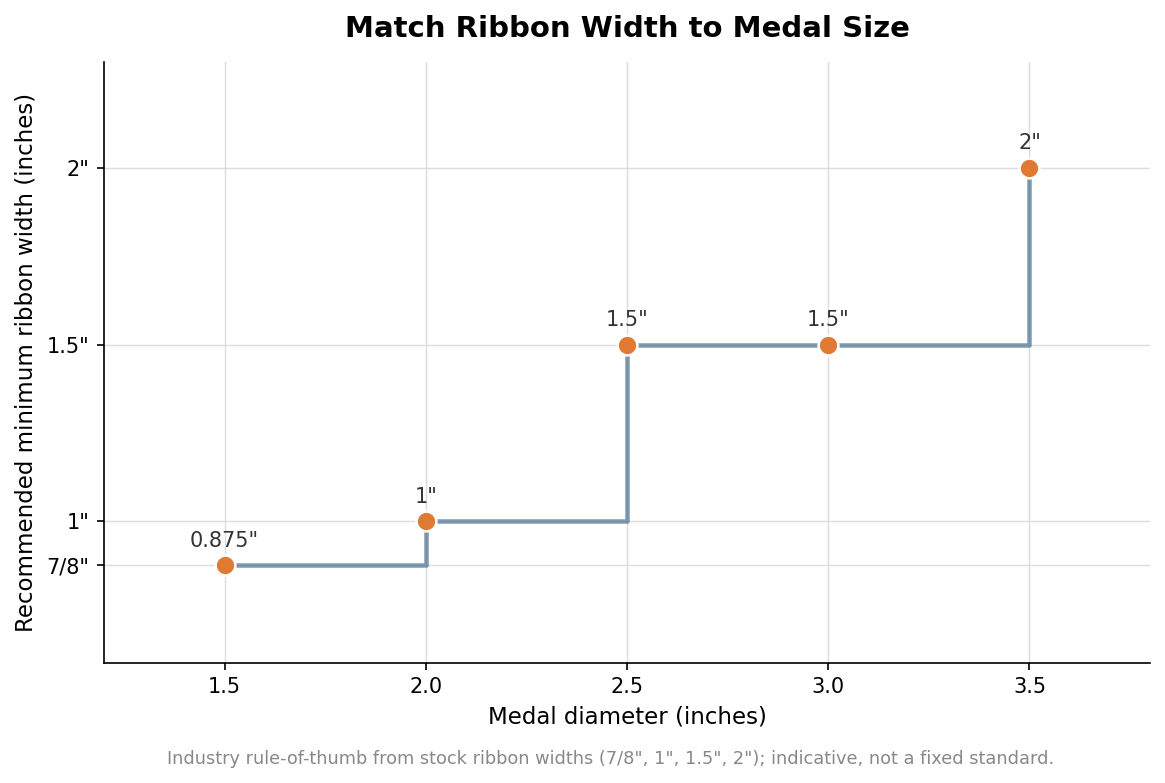
For a 2 inch medal or smaller, a 7/8 inch or 1 inch ribbon keeps the proportions tidy. Standard race finisher medals in the 2.5 to 3 inch range pair naturally with a 1.5 inch ribbon, which is why 1.5 inch is the most commonly ordered width in the running world. Oversized medals of 3.5 inches and up carry a 2 inch ribbon without looking underdressed. These are guidelines rather than rules, and a distinctive design can justify breaking them, but if you have no strong reason to deviate, the proportional step above will not steer you wrong.
Length is about how the medal hangs
Neck ribbon length is usually quoted as the total loop length before it is sewn, and finished drop is roughly half of that. Custom lengths commonly land between 32 and 36 inches of total ribbon, which puts the medal at mid-chest on most adults. Shorter runs toward 30 inches sit higher and photograph well on a stage; longer runs past 36 inches suit costume or themed medals meant to sit low. If your event includes a meaningful number of younger participants, ask whether a shorter kids length is available so the medal does not hang at their waist. Length is cheap to get right at the specification stage and expensive to fix after production.
Choose the print method to match the artwork
There are three common ways to get a design onto a ribbon, and they are not interchangeable. Screen printing lays down one to a few solid colors and is the economical choice for a logo, a simple stripe, or single-tone text. It struggles with gradients and photographic detail. Dye sublimation prints full color into the fabric, handles gradients and complex artwork, and can closely approximate Pantone colors, which is what you want if the ribbon needs to coordinate with a multicolor medal or a sponsor logo. Because the ink becomes part of the fibers, sublimated ribbons resist cracking and washing out. Woven ribbons build the design from the threads themselves, giving a premium tactile feel, but they are the slowest and least forgiving of fine detail. For the large majority of race medals, sublimation is the default because it matches artwork faithfully and does not add much cost at volume.
Decide how the ribbon attaches to the medal
The attachment is a small piece of hardware with an outsized effect on how the medal feels and moves. The most common and economical option is a sewn V-loop, where the ribbon is folded through the medal loop and sewn back onto itself. It is durable and clean, and it is the right call for most finisher and marathon medals. If you want the medal to rotate freely so both sides show, a split ring or a swivel hook sits between the ribbon and the medal and lets it spin, which also reduces ribbon twist on heavier zinc-alloy pieces. A carabiner clip reads as sporty, doubles as a keychain, and suits obstacle and adventure races where participants clip the medal to a bag. Finally, a slot medal skips hardware entirely by casting a slot into the medal for the ribbon to pass through, which looks modern but has to be designed in from the start. Pick the attachment before art is finalized, because a slot or a specific ring changes the medal tooling.
Build lead time in as its own line item
Ribbons are produced alongside the medals, so they run on the same clock. At Customized Race Medals the free mockup comes back within 24 hours and standard production ships in about 2 weeks after you approve it.
Woven ribbons are the slowest to produce and the least forgiving of fine detail, so flag a woven ribbon early when your event date is close. Express shipping is available when a date is tight, but it is not the standard timeline. The practical move is to lock ribbon width, length, print method, and attachment at the same moment you approve the medal art, so nothing waits on a decision you could have made weeks earlier.
A clean specification, in one breath
When you request a quote, a manufacturer wants five things about the ribbon: the width in inches, the total length, the print method, the attachment hardware, and the color reference for the artwork. Handing over all five at once, rather than in a back-and-forth, is the single biggest thing you can do to get an accurate price and an on-target sample. A typical order reads something like a 1.5 inch sublimated ribbon, 34 inches long, sewn V-loop, artwork matched to the medal’s Pantone colors. Specify it that plainly and the ribbon stops being the part of the order you worried about and becomes the part you barely had to think about.