Order custom race medals from your registration count, split by distance and award type, plus a small buffer of spares sized to your race's risk. Customized Race Medals quotes from a minimum of 12 and returns a free mockup within 24 hours, so you can start the design early and lock the final race medals count once registrations settle.
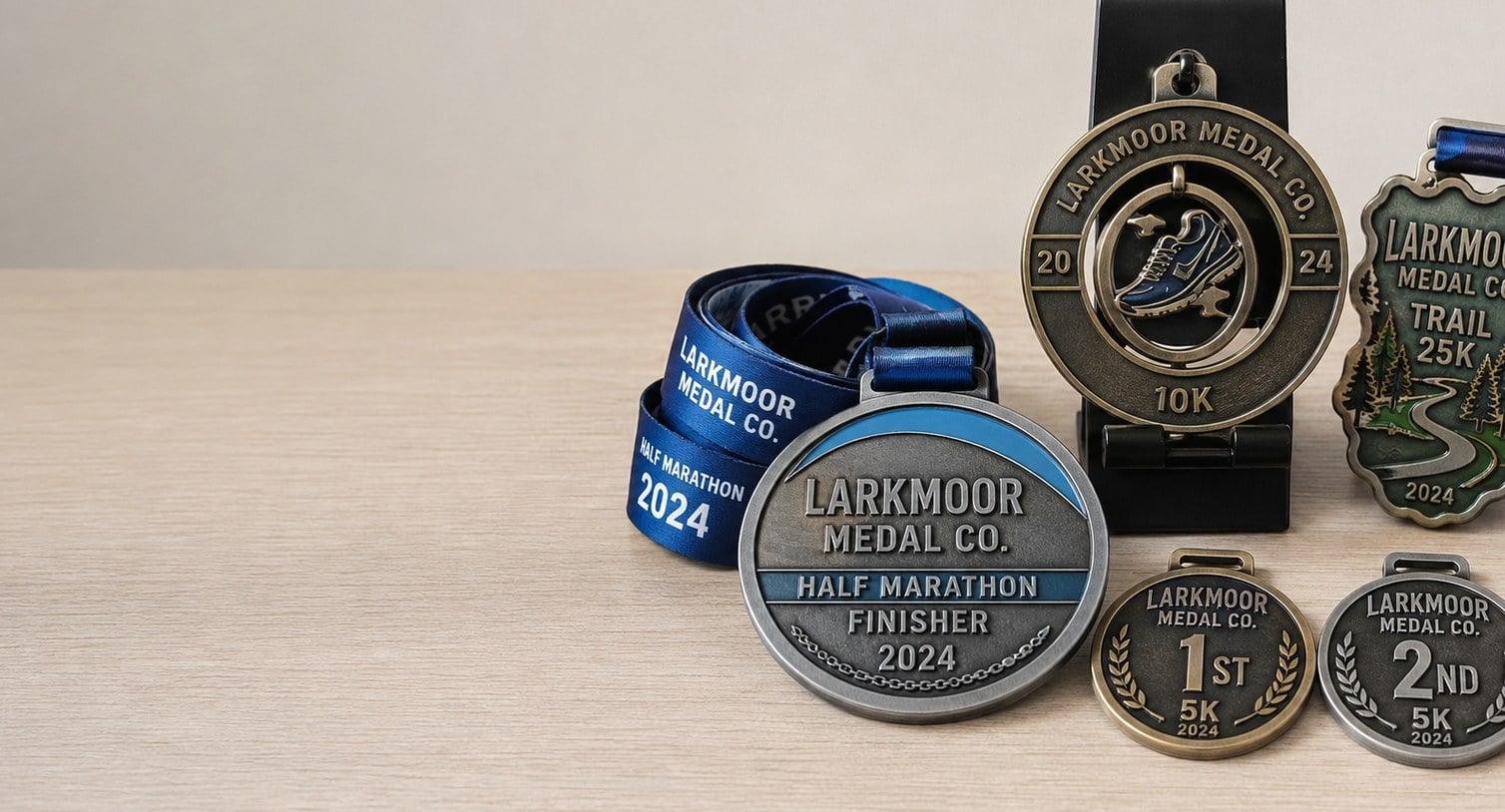
- Count finisher medals from registrations, not last year's finishers
- Give every distance, division and volunteer set its own line
- Minimum order 12 race medals; reorders of approved designs skip the design stage
- Free mockup within 24 hours; pay nothing until you approve
- Standard turnaround about 2 weeks after approval
How many custom race medals should a race order?
The right number of custom race medals starts with your registration count, not your expected finisher count. Order one finisher medal for every registered participant who could cross the line, then add a small buffer for race-day registrations and replacements. Customized Race Medals builds the quote around the number you give, starting from a minimum of 12, so you can size the order to your actual field instead of a round guess.
Most quantity mistakes come from using the wrong base number. Last year’s finisher total feels safe, but it ignores growth, new distances and the runners who register in the final week. A cleaner method is to work from three numbers:
- Current registrations: the count in your registration platform on the day you request a quote.
- Expected late sign-ups: your own history of how registrations climb in the weeks before the race.
- Race-day additions: walk-up entries if your race accepts them.
Add those together for your finisher count, then decide on spares separately. Keeping spares as their own line makes it easier to explain the order to a board, a sponsor or a finance volunteer.
How do you split medal quantities across distances and divisions?
Split custom race medals by distance first, then by award type. Each distance that has its own medal design needs its own count, and each podium or age-group set needs a count per place. Treating the whole event as one number is how a race ends up with plenty of half marathon medals and not enough for the shorter course.
A simple planning table keeps every line visible before you send it to the quote form:
| Medal line | Base the count on | Watch for |
|---|---|---|
| Finisher medals per distance | Registrations for that distance | Runners switching distance near race day |
| Age-group and podium medals | Number of divisions times places awarded | Divisions added for walkers or wheelchair athletes |
| Kids’ dash medals | Youth registrations plus siblings who join on the day | Strong walk-up demand |
| Virtual finisher medals | Virtual registrations | Late virtual sign-ups after the in-person race |
| Volunteer or crew medals | Your volunteer roster | Last-minute helpers |
For podium sets, count divisions carefully. Gender, age band and any adaptive or team categories each multiply the number of award medals. The age-group and podium medals page shows how one design can carry different place markings across a set.
Should spare race medals have the date on them or not?
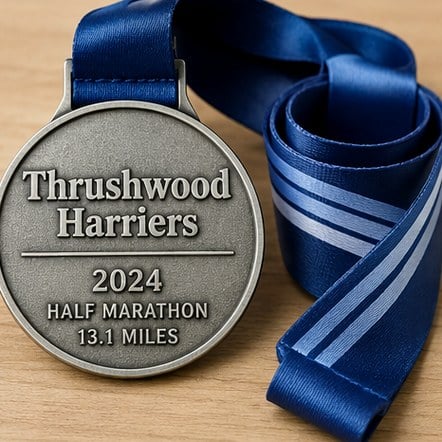
Spare race medals with the full date and year are only useful for this year’s event, so plan spares in two groups. Keep a modest number of dated finisher medals for race-day surprises, and consider a separate set of undated medals for later use. Customized Race Medals can produce both versions in the same project, and the free mockup shows each version side by side before you approve.
Dated spares cover the things that happen on the day: a runner whose medal was dropped in the chute, a finisher who arrived after the medal table packed up, a timing correction that adds a finisher to a distance. Once the event ends, those dated medals have little value beyond the mail-outs you owe.
Undated medals are a different tool. Without a year on the face, a finisher medal can serve:
- a club training series or an informal time trial later in the season,
- a replacement for a runner who loses a medal from a previous year,
- a store of medals for a small charity walk that uses the same race brand.
If the design depends on the date, put the year on the ribbon or the back of the medal and keep the front evergreen. That way the core design stays reusable.
When should you lock in your final medal count?
Lock your final custom race medal count at the latest point that still leaves standard production time before race day. Standard turnaround at Customized Race Medals is about 2 weeks after you approve the design, with faster turnaround available through express shipping. Work backward from your race date, leave a cushion for delivery and packing, and set that as your count deadline.
You do not have to wait for the final number to start. A practical order of steps looks like this:
- Request a quote early with your current registration count so the mockup and pricing conversation begin.
- Review the free mockup, which arrives within 24 hours, and ask for unlimited free revisions until the design is right.
- Keep refining the design while registrations climb.
- Confirm the final quantity on your count deadline and approve the design. You pay nothing until you approve.
Separating design approval from quantity approval in your own planning stops a late registration surge from delaying the medal artwork. The how it works page walks through each step of the process.
Is ordering too many race medals better than ordering too few?
Ordering slightly too many custom race medals is almost always the safer choice, because a runner who finishes without a medal is a problem you cannot fix at the finish line. A short-shipped finisher has to wait for a mailed medal, and that delay shows up in reviews and social posts. A few extra medals in a box after the race costs you far less goodwill.
That does not mean doubling the order. Over-ordering wastes budget that could go toward a better finish, a custom ribbon or a spinner feature. The goal is a buffer sized to your own risk, and these factors raise or lower it:
- Raise the buffer for races with walk-up registration, a first-year event with no history, or a course where volunteers hand out medals quickly.
- Lower the buffer for closed-registration events, small club races and medals that carry the date, since dated leftovers are hard to reuse.
Holiday events and themed runs often see the biggest last-week surge. If your race falls in that season, the custom race medals for holiday races page covers designs built for those events.
How should leftover race medals be stored and used?
Leftover custom race medals stay useful when they are counted, labeled and stored by distance right after the event. Box them by medal line, mark each box with the race name, year and distance, and record the counts in the same file you used to plan the order. That record becomes the best starting point for next year’s quantity.
Store race medals flat in their original bags in a dry space, away from heavy items that can scratch enamel or bend ribbons. Keep ribbons attached so the medals stay matched to the right distance.
Common uses for leftover medals include:
- mailing medals to finishers whose results were corrected after the race,
- sending a medal to a registered runner who could not attend, if your policy allows it,
- using undated finisher medals for club events or replacement requests,
- keeping a few as samples for sponsors when you pitch next year’s partnership.
For races that also run a virtual option, leftovers can feed those mail-outs. The virtual race medals and mailer packs page explains how mailed medals are packed.
Can you reorder custom race medals if you run short?
Customized Race Medals can produce a reorder of the same custom race medal design, and because the artwork is already approved, a reorder skips the design stage. A top-up order still needs production time of about 2 weeks, so a reorder works for mail-outs after the event, not for a shortfall discovered on race morning.
Plan a reorder path before you need one. Keep the approved mockup on file, note the exact ribbon and finish, and write down which distance or division ran short. A reorder still follows the minimum of 12, which suits most top-up needs for a single distance.
A reorder is also the right move for runners who join a later edition of a series. If your race uses a medal series or a connector design, the multi-year and connector medal series page explains how pieces are planned to fit together across years.
The best protection is still the first order. A realistic buffer on your custom race finisher medals keeps reorders for genuine edge cases instead of planning gaps.
Frequently asked questions
What base number should a race director use to count finisher medals?
A race director should count custom race medals from current registrations plus expected late sign-ups, not from last year's finishers. Registrations capture growth and new distances that finisher totals miss. Add race-day walk-up entries if your event allows them. Customized Race Medals quotes the number you give, so a well-built base count leads straight to an accurate quote and a medal order that matches your real field.
How do no-shows affect the number of custom race medals to order?
Custom race medals for registered no-shows are usually still worth ordering, because many races mail medals to entrants who could not attend or keep them as dated spares. If your policy is never to mail medals, you can trim the count slightly using your own history of no-show rates. Keep the trim cautious, since a finisher without a medal is far harder to fix than a leftover.
Do relay teams need one race medal per runner?
Relay teams usually need one custom race medal per runner, since every leg finisher expects a medal of their own. Count relay medals from the number of team members registered, not the number of teams. Customized Race Medals can design relay medals as a matching set or as one shared design, and the free mockup within 24 hours shows how the set will look.
Should volunteers be counted in the race medal order?
Volunteers belong in the custom race medal order as their own line if your event thanks crew with a medal. A distinct volunteer design or ribbon keeps those medals separate from finisher stock, so a volunteer count never eats into runner medals. Customized Race Medals can add a volunteer version to the same project, and you pay nothing until you approve the design.
How many podium medals does an age-group awards table need?
An age-group awards table needs custom race medals equal to every division multiplied by the number of places you award. Count gender, age bands and any adaptive or team divisions separately, since each one multiplies the total. Customized Race Medals can mark places on one shared design, which keeps a large set consistent and simplifies the count.
Can one race order combine finisher medals for several distances?
One custom race medal order can combine finisher medals for several distances, with each distance shown as its own line and its own count. The designs can share a look with different distance labels, or each course can carry a unique shape. Customized Race Medals builds the quote around every line, and the minimum of 12 applies to the order as quoted.
What is the risk of ordering race medals with the year on every piece?
Custom race medals with the year on every piece cannot be reused after the event, so any leftovers lose most of their value. If you expect to carry spares forward, place the year on the ribbon or the medal back and keep the front evergreen. That approach lets dated and undated versions share the same core design and reduces waste.
How should a first-year race estimate its medal quantity?
A first-year race should estimate custom race medals from its registration target, the pace of early sign-ups and similar local events, then add a slightly larger buffer than an established race would. Without history, late registration is the biggest unknown. Customized Race Medals can start the mockup early while the count is still moving, so design and quantity decisions do not hold each other up.
Can a race change its medal quantity after approving the mockup?
A race can usually adjust its custom race medal quantity before final approval, because approval is the point when production is scheduled. Customized Race Medals recommends reviewing the mockup and revisions first, then confirming quantity on your own count deadline. After approval, a change becomes a separate reorder, which follows the standard turnaround of about 2 weeks.
How should spare race medals be divided between distances?
Spare custom race medals should be divided in proportion to each distance's registrations, with a little extra on the distance that sees the most last-week sign-ups. Shorter courses and kids' dashes often grow fastest near race day. Track where you ran short or long after each event, and use that record to shift next year's spares toward the right distances.
Who should sign off on the final race medal count?
The final custom race medal count should be signed off by the person who controls registrations, usually the race director or registration lead, not the person handling the artwork. That person sees late sign-ups first and can confirm each distance line. Customized Race Medals can send the quote and mockup to both people, so design and count are approved together.
Do virtual entrants change how many race medals to order?
Virtual entrants add a separate line to the custom race medal order, because their medals are mailed rather than handed out at the finish. Count virtual registrations on their own, and remember that virtual sign-ups often continue after the in-person race. Customized Race Medals can produce virtual medals in the same design, and leftovers from the race day can supplement late virtual mail-outs.
Get a free mockup for your race medals
Send your logo or idea and the quantity you have in mind. Customized Race Medals returns a free mockup within 24 hours, you approve the design before anything is produced, and standard turnaround is about two weeks with faster options available. Get a custom quote.